Remind and Remember
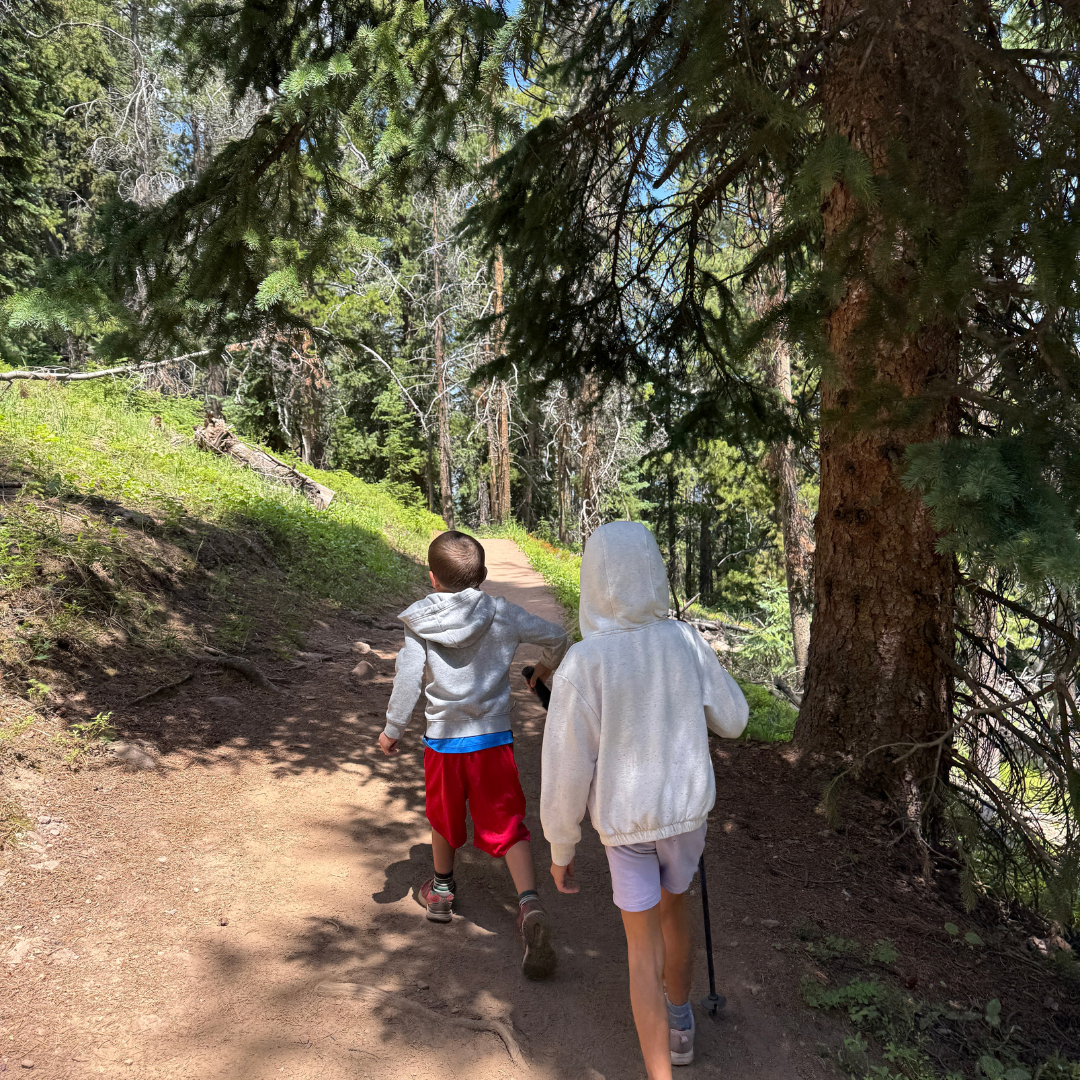
This past weekend, my family and I were hiking a part of Vail Mountain. It was an absolutely beautiful day; the sky was clear, and the scenery was breathtaking. This particular hike was a very easy beginner trail with not much change in uphill and downhill trajectory. The only spot that you had to hike up to was this fun little hideaway with a teepee built into it. It’s the definite highlight of the trail for my kids who love going inside and engaging in all manner of make-believe.
After spending a good amount of time there, we had to hike down a very short but very steep section to get back to the main trail. My son is still learning how to hike trickier sections, so he grabbed onto my husband’s hand and began to waddle/slide his way down. My husband showed him that if he walked on the grassy parts outlining the trail, he wouldn’t slip as much as he did on the dirt path. Out of a habit formed long ago, I asked, “And why is that true?” To which, my 7-year-old daughter promptly replied, “Because of friction, obviously.”
Friends. I wish I could convey how truly show-stopping this answer was. I honestly never thought I would see the day when I got a correct response to that question.
This seemingly insignificant moment began its history two years ago, when our family took our first steps into homeschooling. While this particular path was never, and I mean never, on our minds before kids, it’s one of the most joyful and rewarding decisions we’ve made as a family. My daughter’s kindergarten year was a lot of trial and error, but we started with a fully planned curriculum, which gave us a great foundation to build our routine on. While teaching my daughter how to read has been one of the single best fruits to come from our time together, I’ve also loved exploring history and science with her. It’s different going through all of it from my late 30s perspective. It’s fascinating, exciting, and humbling to rekindle the passion for learning.
Her kindergarten science was focused mostly on the world around us. We learned about bees and ants and how crazy and cool their habits are. We learned about space and the different environments we can find here on Earth. And we took the smallest of steps into bigger ideas like forces and chemical reactions. One of those forces was, you guessed it, friction. We did a whole study on it, and we watched one of my childhood favorite episodes of The Magic School Bus on it. And yet, whenever I asked comprehensive questions about the topic, it was as though my daughter had never heard the word ‘friction’ before.
I started incorporating it into our everyday life. Like when we went skiing or ice skating (“It’s slippery because there’s less friction”) or when we got new tires (“These tires have better tread that has more grip on the road because of friction”). I’ve done this with a lot of other subjects we’ve touched on, but this one in particular never ceased to amaze me as my daughter, time and again, couldn’t seem to make that word stick.
It came up briefly in her 1st-grade curriculum this past year. Again, it was like I was introducing a new foreign word to her. I approached it from different angles and shared all kinds of examples, and it still seemed to go in one ear only to promptly fall out the other (I’m sure there’s a friction joke I could make right there, but I’m just going to move on).
So the fact that on this little family hike we took, it finally clicked in her mind in a way that she actually understood, was enough to make me pause and almost slip on the trail myself.
And if all of this isn’t just the clearest picture of what we do as parents with our kids day in and day out, I don’t know what is.
From the time our children start to understand us, we start teaching them about the world around them. Of course, we all approach this differently, but to some extent, we start setting boundaries, explaining how things work, and sharing the rules we live by as a family unit. At first, these teachings are extremely basic. We teach them the words for different things around them and explain what they are. We introduce the word ‘no’ and teach them which behaviors are acceptable and which are not.
As they grow older, we expand on these basic ideas, giving them more understanding and context for the "why" behind the "what". And it is this stage that can seem fruitless and feel draining because these lessons are not one-and-done. They are put on repeat. For years. Maybe even lifetimes.
We introduced the concept of sharing when my children were just starting toddlerhood, and we still have to remind them to be generous and open-handed with our possessions. We’ve talked about obeying mom and dad since our kids first spoke, and they still find ways to get around that one. I have reminded my kids to ‘practice their patience’ more times than I could count (most of the time, pretty impatiently myself). We have taught them about kindness, love, mercy, forgiveness, true justice, how to speak to other people, how to treat other people, how to handle scary situations, how to handle confusing situations, how to push through the hard times, how to adjust our attitudes (this list could go on forever) for YEARS. And some days, it feels like it’s the first time they are hearing about any of it.
But every now and then, something clicks. It’s there when my son gets up from the dinner table, clears his plate without being asked, and sees that mine is empty, so he takes mine too. It’s evident when my daughter has a difficult math problem in front of her and takes deep breaths and works through it instead of falling apart. It happens when a neighborhood kid starts talking about karma and both my kids say, “We don’t believe in that because that’s not in the Bible,” instead of just going with the flow.
And for all of those breath-taking, treasured moments I have stored in my heart, there are hundreds of hours of missteps, meltdowns, corrections, and reminders that led up to them.
But the idea of reminders is nothing new. It is the reality of every parent, but it is also the reality of our Christian history. Most of Scripture is simply one gigantic reminder. The story of Scripture begins with a promise that one day Satan will be defeated for good (Genesis 3). It continues with a covenant made with Abraham, from whom God’s chosen nation will be born (Genesis 12; 15). Then we see God promise a deliverer for his people from Egypt (Exodus 5:22-6:12), and we watch him raise up Moses to fulfill that promise. We see the incredible and miraculous exodus of God’s people from Egypt into the promised land. And so much of the Old Testament is simply a reminder of everything God has done! The book of Psalms is filled to the brim with accounts of these stories and promises, meant to encourage the Israelites to remember the depth, power, and wonder of the God who chose them and the God they serve (Psalms 33, 77, 78, 89, 104, 105… honestly, there are so many!).
But it doesn’t stop there. Countless promises from the Old Testament find their fulfillment in the coming of our Savior, Jesus Christ (2 Corinthians 1:20). His birth, death, and resurrection were now the new covenant that believers to this day are reminded to look back on. Paul’s letters certainly contain nuances and specific addresses, but so much is simply a reminder about what we already know (Philippians 3:1). Peter wrote his letters to remind the reader to stand firm and hold fast, and encourage them not to forget the Savior who rescued us and the promises to come (2 Peter 1:14-15; 3: 1-3).
Why is so much of Scripture reminding us of so many things? Because we need them. Our own forgetfulness and short-sightedness are simply displayed in 4D in our own children. Their constant need for correction, teaching, and explanation is a hyper-reflection of our own constant need. The simple truth that God has been so patiently faithful to draw us back to him time and again is what gives this area of parenting so much meaning and purpose. We get to continue the long-standing tradition of reminding our kids about all the earthly things, of course. But more than that, we get to remind them, and ourselves in the process, about the wonders of heavenly things.
If this season feels like a particularly challenging one that is fraught with reminder after reminder with no fruit to be seen, take heart. Be encouraged in the story of Scripture at the constant reminding your own heart needs and the loving God who is faithful to do so. Reflect his love, mercy, and kindness to your own children as you raise them in the ways of the Lord. Treasure the moments when the fruit is seen. Stay faithful in the moments when it feels barren. Trust God in all of them.